WELCOME TO THE ACCULTURATION UNIVERSE
WELCOME TO THE ACCULTURATION UNIVERSE
Gaining inspiration from the 2022 film Everything Everywhere All at Once, we created a space to explore themes relating to acculturation. Keep scrolling to see our take on verse-jumping and our individual exhibits that features different forms of media, like Turning Red and Fresh Off the Boat!
Sarah Lyou, Rebekah Kim, Nirmay Bhanderi, Tyler Chan

Quick Recap of Everything Everywhere All at Once
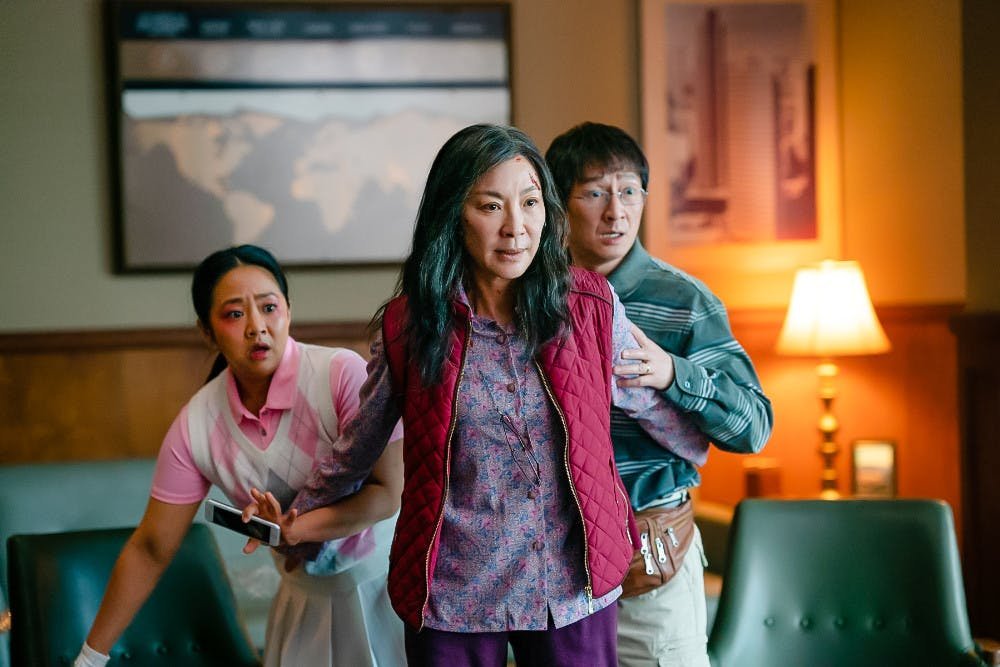
Written and directed by the “Daniels,” this action sci-fi adventure focuses on Evelyn Quan Wang, her father, Gong Gong, her husband, Waymond Wang, and their daughter Joy. Evelyn feels like her world is falling apart as she has to deal with her laundromat being investigated for tax evasion, Waymond filing for a divorce, having to take care of Gong Gong, and Joy’s growing distance from her. One day, when Evelyn and Waymond are at a meeting with the IRS, Waymond explains the “Alphaverse” to Evelyn, in which many parallel universes exist as every life choice creates a new universe and path in life. Within these universe, “verse jumping” technology allows people to access skills, memories, and bodies of their parallel-universe selves. Throughout the film, Alpha-Waymond and Alpha-Evelyn battle Jobu Topaki, the Alphaverse version of Joy, and Alpha-Evelyn is tasked with destroying the multiverse. Throughout all of the chaos, Evelyn learns to find her happiness and mend relationships with those around her. This film dives into numerous themes pertaining to Asian American individuals, many of which we cover on this page.
Connection to Acculturation
Our group theme is the stress that comes with acculturation. Acculturation is the process of cultural change that occurs when individuals from one culture adopt the customs, practices, and values of another culture, usually of the country they immigrate to. This overarching theme relates to our individual themes of job/life dissatisfaction, intergenerational trauma, cultural gap/identity, and parental love in Asian American families. The stressors resulting from acculturation in Asian American families can include the conflict of trying to maintain one’s own values and assimilating to new ones.
Moreover, acculturation has resulted in a constant struggle between preserving one’s heritage while adjusting to mainstream U.S. culture. This balancing act creates cultural gaps between generations within families, leaving a growing population of second generation Asian Americans struggling to navigate their own connections to their cultural identities and experiences growing up in the United States.
Although intergenerational trauma may stem from a place of historical trauma, the lasting effects of intergenerational trauma go hand in hand with stressors resulting from acculturation. One main impact of intergenerational trauma on younger generations is the lack of communication between parents and their children. This relates to the notion that when Asian immigrants move to the U.S and adopt Americanized beliefs and values, they may wish to forget about the past and “start over.” Thus, the process of acculturation allows the older generations who endured this trauma to easily ignore that part of their life and have their children never learn about it.
In the context of family dynamics, the way parental love is expressed in Asian American families is different from typical American families because of the stressors from acculturation, such as discrimination and communication barriers. Parental love is related to intergenerational trauma in Asian American families and can significantly affect how parents express love towards their children. When Asian American immigrant parents have trauma from their parents, they will often project their experiences onto their children, and this can lead to fixed expectations of certain occupations that connect to the job dissatisfaction many Asian Americans face.
The idea of acculturation relates to the idea of work ambivalence because often times the factors that influence job dissatisfaction and views on work amongst Asian Americans are the same that lead to acculturation. Particularly, the idea that Asian Americans have different cultural values than other Americans and thus when those Asian American values are abandoned through acculturation, there is an increase in satisfaction and happiness.
Individual Project Overview
Below is a short description of each group member’s individual exhibit.
-
Tyler’s individual exhibit focuses on the idea of cultural identity by studying the family dynamics in Everything Everywhere All At Once. This exhibit analyzes the unique experiences of different generations of Asian American families and further explores the effects of a cultural gap on the development of an individual’s cultural identity. Scroll up to find the “Cultural Identity” button and click on it to learn more.
-
Sarah’s individual exhibit explores intergenerational trauma in Everything Everywhere All At Once. This exhibit analyzes the mother-daughter relationship between Evelyn and Joy in the film and introduces various media objects, such as films, books, and social media platforms, that further explain the effects of intergenerational trauma on Asian American families. Scroll up to find the “Intergenerational Trauma” button and click on it to learn more.
-
Rebekah’s individual exhibit explores parental love in Everything Everywhere All At Once by analyzing Evelyn and Joy’s complicated relationship and connecting it to several other films and shows. Each clip focuses on an important element, such as support, encouragement, or respect, that should exist in a healthy parent-child relationship. Scroll up to find the “Parental Love” button and click on it to learn more.
-
Nirmay’s individual exhibit focuses on work ambivalence within Asian American families by exploring the connection between work and happiness in Everything Everywhere All At Once. This exhibit explores the various factors that contribute to job dissatisfaction and explores its effects on family dynamics. Scroll up to find the “Work Ambivalence” button and click on it to learn more.
Important Terms
-
Historical trauma is “multigenerational trauma experienced by a specific cultural, racial, or ethnic group. It is related to major events that oppressed a particular group of people because of their status as oppressed… involves the additional challenge of a damaged cultural identity…” 1 Historical trauma is important to Asian American sociology because historical events, such as the Korean War and the Japanese internment, have not only forced Asian families out of their homes into the U.S., but also impacted the social development of generations to come. This relates to the theme of acculturation because it shows how Asians are forced to assimilate to the dominant Western culture in the U.S.
-
Acculturation refers to the process of absorbing traits and assimilating into the dominant culture in one’s environment. Acculturation also results in the loss of the primary or original culture and is often seen in immigrants who are trying to fit into a new society. 2 Acculturation relates to sociology since the immigration process is usually a significant event in most Asian American experiences and acculturation is important to understanding sociological effects surrounding immigrants.
-
Cohesion refers to the idea of unification and having a united group. Family cohesion is when a family is emotionally bonded and united. 3 More cohesive families are often more supportive of each other and show higher levels of commitment to each other. Family cohesion is an important topic to study within Asian American families since many Asian American families have lower family cohesion due to the stress of acculturation and intergenerational trauma. Family cohesion is also extremely important because it determines how supportive a family is, which can affect each person’s mental health and happiness.
Click to learn more about each term.
References
Franco, F. (2021, Jan 8). Understanding Intergenerational Trauma. Good Therapy. https://www.goodtherapy.org/blog/Understanding_Intergenerational_Trauma
Cole, N.L. (2019 Nov 8). Understanding Acculturation and Why It Happens. ThoughtCo. https://www.thoughtco.com/acculturation-definition-3026039
Rivera, F. I., Guarnaccia, P. J., Mulvaney-Day, N., Lin, J. Y., Torres, M., & Alegria, M. (2008). Family Cohesion and its Relationship to Psychological Distress among Latino Groups. Hispanic journal of behavioral sciences, 30 (3), 357–378. https://doi.org/10.1177/073998630831871
Photos:
Movie Time. (2022 May 26). Everything Everywhere All at Once - Verse Jumping Compilation. [Screenshot from Video]. Youtube. https://www.youtube.com/watch?v=QoVOO5gJ1yI
Allyson Riggs, Photo of Evelyn, Joy, and Waymond, A24 Films, Accessed 13 December 2022, <https://romesentinel.com/stories/capitol-screens-everything-everywhere-all-at-once,132803?>