Work Ambivalence

Evelyn and Deirdre sitting in front of the laundromat¹
The relationship between Asian Americans and work is a very complicated one. As a result of various cultural issues such as expectations of pursuing certain careers, parenting styles, and the purpose people find within work, the way that Asian Americans perceive work is very different from other populations and has a major impact on job satisfaction. The film Everything Everywhere All at Once depicts an interesting relationship between work and happiness as the main character Evelyn works at a laundromat which is struggling to have success and also being audited by the IRS. Evelyn’s situation is a very interesting look at this relationship because she works in a non-traditional job as well as a role that generally isn’t considered conventionally attractive. While at times in the film, we see that Evelyn seems to gain some satisfaction from her work. However, there are certain moments when it is clear that Evelyn yearns for more purpose from her work. One moment that stands out is in the beginning of the film when we see Evelyn hustling to ensure the laundromat runs properly. It is clear in this moment that she cares about the success of the laundromat even if she appears frustrated as she deals with customers and her family simultaneously. After this moment of work, she is seen reflecting on her past while looking at a dry cleaning ticket in a flashback of her leaving home and starting the laundromat which makes it clear that Evelyn has regrets and is not fully fulfilled by her monotonous work in the laundromat. Evelyn is torn between her responsibility to provide for the family and continuing to put 100% into her work with her longing for more meaning in the work she does. This binary is found in many descriptions of Asian Americans who are dissatisfied with their work as they do not find meaning in their work but still feel a obligation to excel in their work. Research on Asian American culture and Asian Americans’ views on work offer an insight into why Evelyn continues to work even if she does not feel a strong sense of purpose. A study conducted by Weaver in 2001 found, “Asians do not think of jobs as a source of happiness but simply as a means of earning money to underwrite other aspects of their lives, such as the well-being of their families, which are the main sources of their happiness."2 This is where the ambivalence in attitudes towards work is clear as some Asian Americans understand the necessity of work but don’t see the need to be passionate which can lead to unhappiness within the working environment as the work tires people out over time.
Research on workers during the Covid-19 pandemic compounds this view of work as Christina Ong writes, “Southeast Asian workers working in meatpacking facilities described the fear of speaking out against poor labor conditions and feelings of being desensitized to COVID-related illness and death in their communities. Such findings raise questions about coping mechanisms that Asian and Pacific Islander workers in precarious industries use to deal with extreme risks and social pressures.”³ Even in careers which are legitimately dangerous and low paying, the burden to work and contribute to the family overrides any concerns about job satisfaction. Asian Americans are thus more likely to be dissatisfied with their work and yet still continue to perform well. The same class based dynamic where Asian Americans who work at low level blue collar jobs are forced to prioritize staying employed over being safe within their work and being content with it. Preeti Sharma’s analysis of Covid-19 reopening policies found that “such social relations are predicated on a need for, and the disposability, of Asian American nail salon worker’s affective labor to perform services rendering comfort and normalcy despite the risks of the virus.”⁴This source goes so far as to say that the dependency on Asian Americans and the expectation that they will work, in this case that they must work, was taken advantage of during the pandemic reopening.
When looking at the origins of this view on work and the meaning of work, several things about Asian American culture stand out. Several surveys have found that Asian American conceptions of happiness and a more collectivist culture compared to Westerners may have an impact on the relationship between Asian Americans and work. Sheila Henderson’s study in 2005 found that there are two reasons for Asian Americans having lower job satisfaction even when “factors like occupation type, education, income, and age were taken into consideration”. Henderson explains that there are, “two explanations for this phenomenon: first, that Asian Americans have higher job expectations than other cultures; second, that jobs are not a source of happiness for Asian Americans as they may be for people with a Western orientation.”⁵ This supports the earlier idea that happiness is not necessarily a goal for a job but other factors supersede that for Asian Americans. Another aspect of Asian American culture which Henderson looks at is the trait of humility. As Henderson explains, “The authors of this study concluded that the Chinese culture’s emphasis on humility and modesty can shape a person to become less independent and autonomous. It is not hard to imagine that individuals who adhere to cultural values of modesty and self-effacement might find themselves being overlooked for promotions or advancement and might thus feel frustrated and unhappy”.⁶ This explanation of Asian American cultural values gives insight into the behaviors that are expected of Asian Americans and often inescapeable part of the Asian American work experience. Unlike some of the other factors discussed, certain ideals and behaviors which are perceived as being “Asian” can serve as a silent but negative influence on work satisfaction. The other part of this theory which discusses higher expectations coincides with the model minority myth which is broadly applied to Asian Americans. Both within the culture and as seen by outsiders, Asian Americans are associated with high paying and highly educated careers such as physicians and engineers so when Asian Americans are unable to secure these jobs, they are naturally unsatisfied with their work since the outside view is also unfavorable of “less prestigious” careers. This emphasis of prestige within Asian American culture explains why even though “It is also reported that Asian American are more like Euro-Africans in income, educational attainment, academic performance, and occupational representation” that “Pair-wise comparisons were significant between Euro-American and Asian Americans."⁷ This study which surveyed Asian Americans and Euro Americans compared each demographic to their years of education, income, white-collar percentage, and job satisfaction supports the idea that culture has a major impact on how people view their work. The positive aspect of Asian American cultural beliefs must also be considered as the collectivist culture can lead to a better relationship with work as Asian Americans are focused on the greater good of an organization in the same way that they are expected to contribute to their families and larger social structures. For example, a study on Asian nurses in the US found that “all the participants had median to high scores on collectivist orientation and organisational commitment” because “people born in the East Asia and raised in a collectivist culture are more collectivistic.”⁸ This orientation towards collectivism gives an opposite influence compared to the negative influences of culture by leading Asian Americans to form bonds easier and find community within work.
An interesting caveat to the theories discussed earlier is that they primarily rely on the experiences and beliefs of immigrants and those who have not been particularly vulnerable to the effects of acculturation. It is very interesting, though, to examine the effects of acculturation on younger generations and how they view work. Although acculturation tends to have negative effects in general, often assimilating to more Western understandings of work satisfaction can have positive effects on the relationship between Asian Americans and their work lives. Nguyen conducted a study on faculty at universities and their career satisfaction and found, “Acculturation also played a role in understanding career satisfaction. For those born overseas, an API cultural orientation predicted higher career satisfaction. This may be because they actually felt more satisfied, or because they reported higher career satisfaction due to the API values of contentment (being satisfied with what one has) or fatalism (accepting things as they are."⁹ Nguyen argues that keeping cultural values can actually boost career satisfaction which may help offer an explanation for how Evelyn draws happiness from her work without much on the surface level that is exciting or fulfilling. On the other hand, Henderson proposes the opposite explanation by writing, “At the same time, current findings indicate that happiness and well-being are culturally influenced but not culturally deterministic. Asian clients who are more acculturated to Western orientations may express themselves more individualistically.”¹⁰ This idea that assimilating to Western culture and adopting an individualistic point of view where one favors their own happiness over collective groups definitely has potential to be true but is more applicable to those who have felt a strong pull from acculturation such as those who are second generation or more exposed to Western culture.
Thus, the relationship between work and Asian Americans is influenced by various cultural factors, some negative and some positive. There is very little direct evidence of any values or influences leading to work dissatisfaction since the relationship is very complex and, as in the case of Evelyn from Everything Everywhere All at Once, can vary depending on time and place. Below, I analyze several depictions of work relationships within media and how these relate to the different concepts discussed above.
Career Representations in Media

Jung from Kim’s Convenience
-
Jung is a character in the show Kim’s Convenience who, after being kicked out of his home and never graduating high school, ends up working a low-level role at a car wash. This is the subject of discussion amongst the Korean women who are part of his mom’s church as they compare him to their children who pursue more conventionally successful careers. This is a very direct and exaggerated way of showing how the Asian American community’s views can influence work satisfaction. Although Jung clearly enjoys his job and is successful at it, it is clear that the views of the community do impact him and how he views his job. This representation does an excellent job of showing the ambivalence of work within Asian American communities as personal ideas of fulfillment often clash with societal perception.
Jung, portrayed by Simu Liu, depicted at his job at Handy Car Wash in the tv show “Kim’s Convenience.”¹¹
Fresh off the Boat
-
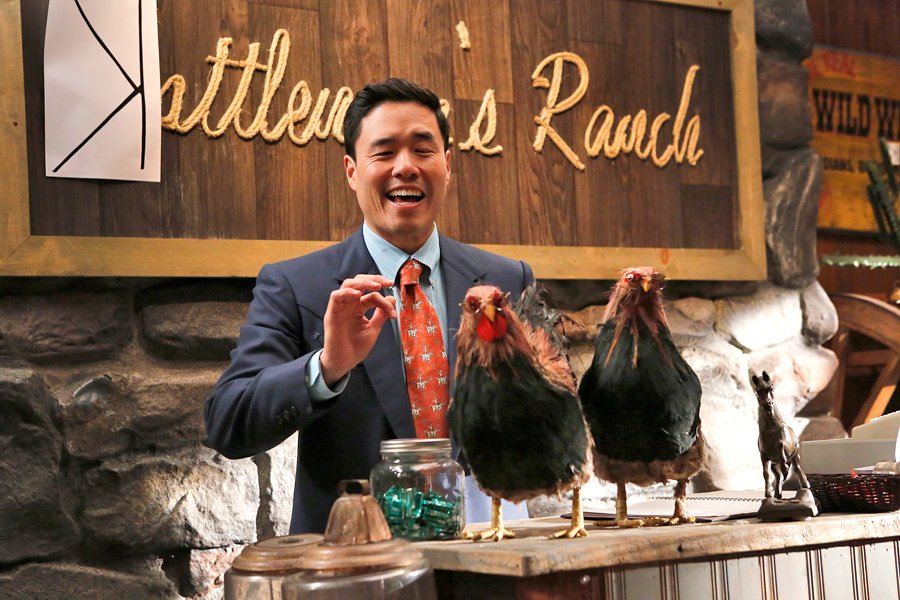
In Fresh off the Boat, the father of the family Louis Huang is seen operating a steakhouse called Cattleman’s Ranch. This interaction with work offers a look into a more assimilated version of Asian Americans working unconventional careers. We see how Louis conforms to American ideals and takes up an almost fully American persona to promote business in his restaurant. While this is primarily a marketing tactic, Louis does seem to have a real purpose in ensuring the success of the restaurant both to support his family but also as a source of pride. This helps demonstrate the idea that finding purpose in work is a significant prerequisite to being satisfied with your work.
Louis Huang, portrayed by Randall Park, seen here working at his steakhouse Cattleman’s Ranch in the show “Fresh off the Boat.”¹²

Mateo from Superstore
-
In Superstore, the character Mateo is an undocumented Filipino man who is extremely motivated to succeed within the environment, almost to the point where he seems like a stereotypical depiction of the model minority myth. Although he does grow throughout the show to lose the one-dimensional attribute of just being a hyper focused Asian immigrant focused on success. Initially, we see that Mateo is not necessarily working hard because he is passionate but rather just because it is part of his personality and culture. This represents the more negative aspect of Asian American cultural influence of work ambivalence which focuses on excellence without concern about purpose. However, as the show continues, we see that he embraces the collectivist nature of Asian Americans and finds a community within the store that helps him build purpose and ultimately be more satisfied with his work. Mateo has a relationship with work that is depicted throughout the show, and we see the growth from a model minority stereotype to a multidimensional character with a complicated relationship with work.
Mateo , portrayed by Nico Santos, working at his job as a cashier in the titular superstore in the tv show “Superstore.”¹³

“The Model Minority Myth” by Michael Chem
-
The model minority myth.
Aka the greatest myth ever created to divide people of color in America
It feeds into the oppression olympics by telling our fellow minorities that Asians can do well in America…
So why can’t you?
Forget about all the subconscious biases that still exist in society
Forget about all the institutionalized racism in corporate America
Forget about having to come from
Broken homes,
broken schools,
And broken dreams
None of that matter
right?
All you have to do is work hard in order to be successful
Ignore all the negative stereotypes and policies created to oppress our communities
Ignore the fact that mainstream media propaganda portrays anyone with brown skin as foreigners or thugs
Ignore the fact that some of us can barely afford a meal, let alone a tutor
Asians can do it,
So why can’t you?
Asian-Americans have the highest median income of any racial group, including whites
They also graduate from high school and college at a higher rate than other racial groups
But when we disaggregate the data,
We see a completely different story.
What they don’t tell you
is that Asian-Americans also have the highest income gap of any racial group
They hyperselect the highest achieving Indians, Taiwanese, and Filipino while the refugee immigrants from Southeast Asia have a much harder fight.
Cambodians, Hmong, Laotians, and Vietnamese have a lower median income than most ethnicities and are graduating at a lower rate
Are they still a part of the “model minority” that mainstream media wants everyone to strive for?
Are their stories of struggle and perseverance to immigrate to America just going to be ignored because they fall under the Asian-American umbrella?
How can you possibly group everyone in the largest continent on Earth into one category?
17 million square miles, 4.5 BILLION people, and there are hundreds of different cultures, traditions, and languages
Although the Southeast Asian communities aren’t currently as successful as the model minority stereotype makes them out to be
I believe that Southeast Asians have the potential to achieve as much success, if not more, than their peers
But the model minority myth greatly inhibits their abilities
It causes teachers to subconsciously expect more from them and expect them to do well in courses such as math and science
If they don’t do well, they are labelled as lazy and unwilling to work hard
When in reality, they could be working just as hard, or even harder than their peers
This needs to be addressed sooner rather than later
The constant pressure of having to achieve good grades and the constantly rising bar that you have to strive for?
It’s no surprise that Asian-American youth that don’t live up to the expectations that stem from the myth develop mental health issues
It becomes worse due to the stigma surrounding mental health in the Asian communities
If you tell your parents you’re stressed, they tell you…
“You don’t even know what stress is! I raised you and do everything for you!”
If you tell them you have trouble getting out of bed because you have depression, they tell you...
“Get over it and go out! Quit being lazy and do something!”
If you tell them you have an eating disorder, they tell you...
“Stop being stupid and just eat! Don’t waste your food, there are other kids in the world who aren’t as lucky as you!”
Ignore the fact that our parents and ancestors lived through a war and were in life or death situations, seeing family, friends, and strangers die right in front of them
Ignore the fact that they came from a third-world country and were forced to assimilate and lose most of our culture in order to survive in America
There’s no way any of them have any mental illnesses
Mental illness is a lie and it’s all in your head
Just get over it and live you life
It’s not like suicide was the leading cause of death in 2017 among Asian-Americans, age 15-24
None of this matters in our culture
Mental illness is a sin and if you think you have a mental illness, you better grow up and get over yourself
These stigmas need to end in order for our communities to grow and prosper together
It is our responsibility to help the next generation
We must dispell this myth and any other stereotypes in our communities
We must see people as individuals rather than putting them in groups based on race
We must come together as a community and change the culture
We cannot make the same mistakes as past generations
I can see a future filled with:
Understanding rather than judging
Unity rather than division
And Love rather than hate
So why can’t you?
-
This poem presents a stark difference between the high achieving Asian America which is depicted through the model minority myth with those who struggle to achieve success as a result of different societal inhibitors. It offers an interesting look at how the external view of Asian Americans by other people can lead to a lack of motivation as Asian Americans are taught that as the model minority they must achieve the conventional paths of success. When people are unable to reach that level of success, there is a natural progression to work dissatisfaction since they compare themselves to this idealized model which is unrealistic for most people. This helps us look at how mentality affects work relationships.
“But the model minority myth greatly inhibits their abilities
It causes teachers to subconsciously expect more from them and expect them to do well in courses such as math and science
If they don’t do well, they are labelled as lazy and unwilling to work hard
When in reality, they could be working just as hard, or even harder than their peers”
-quote from poem (make sure to read full poem)¹⁵
An image created to accompany the poem which represents the fence separating Asian Americans from broader American culture even with the broad model minority myth.¹⁴
The Wind-Up Bird Chronicle by Haruki Murakami
-
The Wind-Up Bird Chronicle by Haruki Murakami gives us a look into the Asian cultures which influence much of the cultural values that have been discussed as impacting work ambivalence but without any American influence. The novel is set in Japan and thus we don’t see any American assimilation but instead see how the main character Toru Okada deals with work in a purely Asian context. At the beginning of the novel, Toru quits his job as a low-level lawyer’s assistant and abandons his goal to become a lawyer. We immediately see how this impacts others’ views of him after this change as his wife begins to act cold and there is a clear decrease in respect which shows how even though he abandoned his work due to a lack of purpose, it would possibly have been better for him to continue his work and put up with his dissatisfaction in order to preserve his image in the community. This again demonstrates the link between cultural perception of work and job satisfaction.

An illustration representing the struggle of finding agency within the novel.¹⁶
Notes
Valerie Wu, 2022, From left, Jamie Lee Curtis, Michelle Yeoh, in “Everything Everywhere All at Once,” A24, Accessed 16 December 2022, <https://dailytrojan.com/2022/03/28/everything-everywhere-all-at-once-is-something/>
Weaver, Charles N. “Contribution of Job Satisfaction to Happiness of Asian Americans.” Psychological Reports 89, no. 1 (2001): 191–98. https://doi.org/10.2466/pr0.2001.89.1.191, 1.
Christina Ong, Amy Zhang, and Vivian Shaw, “Asian American, Asian Immigrant, and Pacific Islander Businesses and Workers during COVID-19,” Natural Hazards Center (National Hazards Center, 2021), https://hazards.colorado.edu/quick-response-report/asian-american-asian-immigrant-and-pacific-islander-businesses-and-workers-during-covid-19.
Sharma, Preeti. "Irresponsible State Care and the Virality of Nail Salons: Asian American Women's Service Work, Vulnerability, and Mutuality." Journal of Asian American Studies 23, no. 3 (10, 2020): 491-509. doi:https://doi.org/10.1353/jaas.2020.0037. http://proxy.library.vanderbilt.edu/login?url=https://www.proquest.com/scholarly-journals/irresponsible-state-care-virality-nail-salons/docview/2465811088/se-2.
Henderson, Sheila J., and Anne Chan. “Career Happiness Among Asian Americans: The Interplay Between Individualism and Interdependence.” Journal of Multicultural Counseling and Development 33, no. 3 (2005): 180–92. https://doi.org/10.1002/j.2161-1912.2005.tb00015.x, .
Henderson, “Career Happiness Among Asian Americans: The Interplay Between Individualism and Interdependence.”
Weaver, Charles N., and Shelley Hinson. “Job Satisfaction of Asian Americans.” Psychological Reports 86, no. 2 (2000): 586–94. https://doi.org/10.2466/pr0.2000.86.2.586, 587,591.
Liou, Shwu-Ru, Hsiu-Min Tsai, and Ching-Yu Cheng. “Acculturation, Collectivist Orientation and Organisational Commitment Among Asian Nurses Working in the US Healthcare System.” Journal of Nursing Management 21, no. 4 (2013): 614–23. https://doi.org/10.1111/j.1365-2834.2012.01447.x, 620-621.
Nguyen, Angela-MinhTu D., Que-Lam Huynh, and Jennifer Lonergan-Garwick. "The Role of Acculturation in the Mentoring-Career Satisfaction Model for Asian/Pacific Islander American University Faculty." Cultural Diversity and Ethnic Minority Psychology 13, no. 4 (10, 2007): 295-303. doi:https://doi.org/10.1037/1099-9809.13.4.295. http://proxy.library.vanderbilt.edu/login?url=https://www.proquest.com/scholarly-journals/role-acculturation-mentoring-career-satisfaction/docview/614481413/se-2.
Henderson, “Career Happiness Among Asian Americans: The Interplay Between Individualism and Interdependence.”
Kim’s Convenience Twitter, Simu Liu, in “Kim’s Convenience,” Thunderbird Films, Accessed 16 December 2022, <https://twitter.com/KimsConvenience/status/1246816128711774208/photo/2>
Will Robinson, 2016, Randall Park, in “Fresh off the Boat,” 20th Century Fox Television, Accessed 16 December 2022, <https://ew.com/recap/fresh-off-the-boat-season-2-episode-13/>
Rotten Tomatoes, 2016, Nico Santos, in “Superstore,” NBC, Accessed 16 December 2022, <https://www.rottentomatoes.com/tv/superstore/s02/e03>
Michael Chem, The Model Minority Myth, 2019, https://www.theseadproject.org/projects_library/michael-chem/.
Michael Chem, “The Model Minority Myth",” The Southeast Asian Diaspora Project, 2019, Accessed 16 December 2022, https://www.theseadproject.org/projects_library/michael-chem/.
Varsam Kurnia, "The Wind-Up Bird Chronicle,” Behance, 2016, Accessed 16 December 2022, https://www.behance.net/gallery/40881477/The-Wind-Up-Bird-Chronicle.