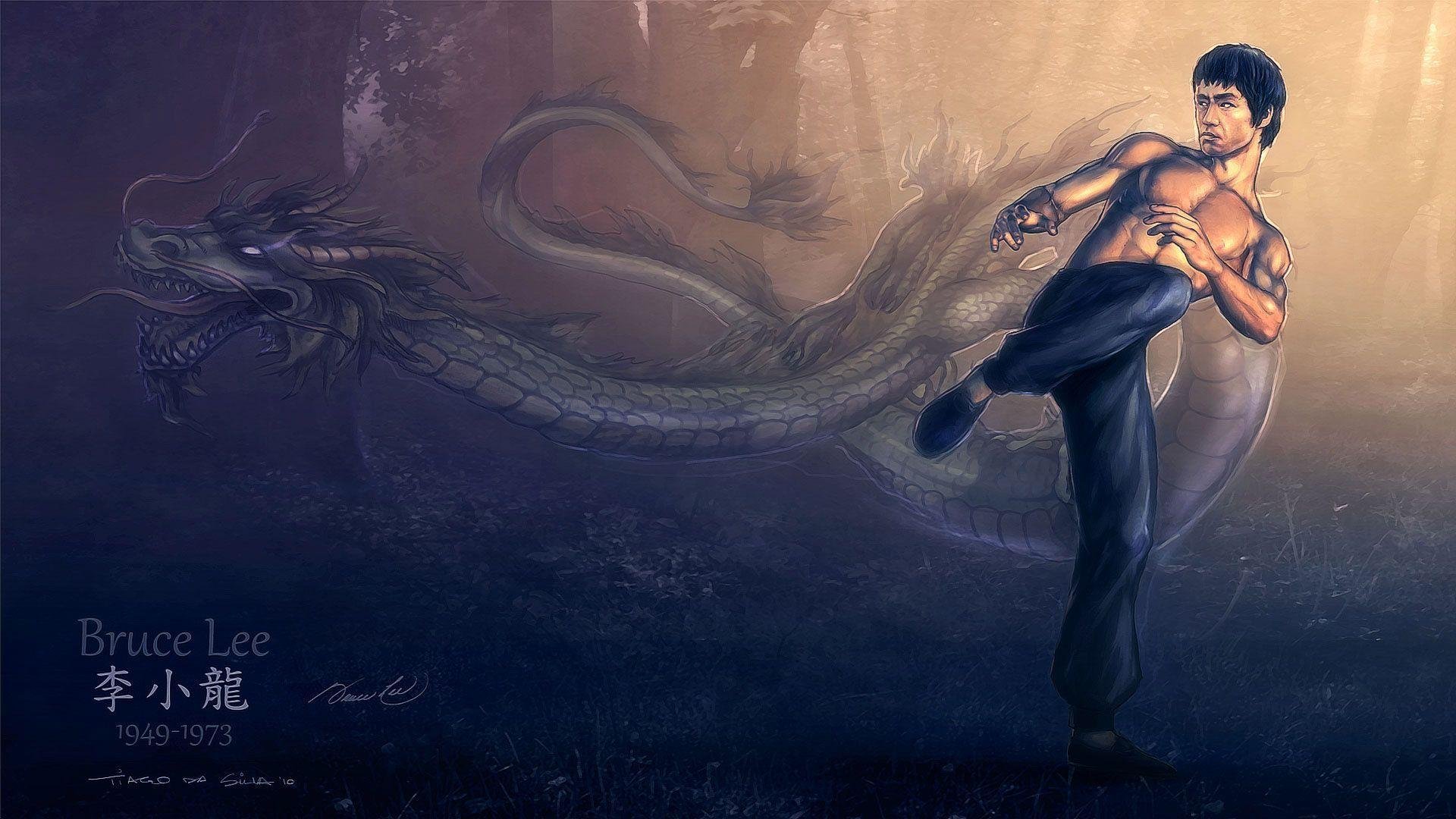
“Be Water”
Bruce Lee
[1]
Film Summary
[2]

In Bao Nguyen’s documentary “Be Water”, he explores Bruce Lee’s life and experiences using rare archival footage, memories from relatives, and Lee's own words in interviews and media appearances. The documentary is notable for being part of ESPN’s “30 for 30” series, which typically focuses on sports figures, with Lee's inclusion highlighting his significance in the realm of martial arts and beyond. The film specifically focuses on Lee's two years in Hong Kong where he filmed four feature films, delving into his struggles in both America and Hong Kong, and exploring his quest for identity and representation. [1]
-
Bruce Lee revolutionized global perceptions of martial arts through his innovative philosophy and practice, transcending cultural barriers and redefining the genre. The documentary illustrates how Lee's philosophical approach to life and martial arts helped him transcend racial and cultural barriers, embodying the very essence of being like water – adaptable, resilient, and transformative.
-
By becoming a leading man and a sex symbol, he redefined Asian American masculinity, challenging the prevailing stereotypes of Asian men as feminine or submissive. Lee challenged the prevalent emasculated portrayal of Asian men in Western media, instead presenting a strong, charismatic, and multidimensional figure. His assertive presence and dynamic martial arts prowess in the film industry not only broke traditional molds but also established a new archetype for Asian American masculinity.
-
Bruce Lee revolutionized American culture, particularly through his media presence. Bruce Lee revolutionized kung fu cinema not only by increasing its authenticity and combativity but also by revealing its inherent connection to martial ideation, providing a larger scope and setting the stage for many Asian Americans in Hollywood combat films.
-
His films and persona spoke to diverse audiences, challenging the notion of cultural purity and demonstrated the potential for cross-cultural exchange and understanding. In form, he popularized martial arts worldwide which directly translated to the power of cultural forms in challenging racial and cultural stereotypes.

Bruce Lee explains his philosophy in an interview excerpt. [3]
Introduction
In the large span of Asian American cultural history, few figures have had as immense an impact on the representation and identity of Asian Americans as Bruce Lee. A martial artist, actor, and philosopher, Lee not only challenged long-standing stereotypes but also redefined the scope of Asian American masculinity and visibility in competitive fields. The aim here is twofold: to explore the profound ways in which Bruce Lee's life, philosophies, and career challenged and reshaped the prevailing narratives about Asian Americans, particularly in the field of competition, and to juxtapose these developments within the historical and contemporary contexts that define Asian America. This essay seeks to explore Bruce Lee's profound influence on Asian American identity and representation, as depicted in the 2020 documentary 'Be Water' by Bao Nguyen, positioning his legacy within the broader sociological and interdisciplinary frameworks that dissect the Asian American experience. [2]
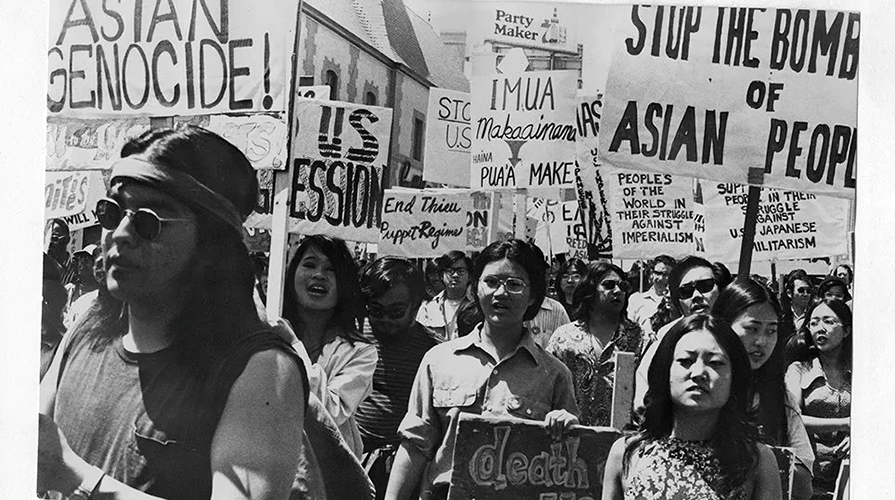
Asian American Cultural Landscape: A Labyrinth of Vibrant Diversity
[4]
To fully comprehend Bruce Lee's impact, it’s important to contextualize the Asian American landscape within the historical struggles and societal challenges that have shaped it. The Asian American experience is marked by a complex interplay of factors such as war, colonialism, discrimination, migration, labor, and social movements. The arrival of Asian Americans in the United States, particularly during the California Gold Rush, was initially met with heavy suspicion and resistance. This was further worsened by geopolitical tensions due to fear of espionage, especially during World War II, leading to heightened scrutiny and mistrust of Asian communities. A significant display of this discrimination was the Chinese Exclusion Act of 1882, which not only banned new Chinese laborers from entering the country but also deprived those already residing in the U.S. of the opportunity to become naturalized citizens. [3] Collectively, these events have molded the Asian American identity, often underscoring a narrative filled with discrimination, marginalization, and resilience that is pivotal in understanding the societal landscape that shaped figures like Bruce Lee and their profound influence on Asian American identity and representation.

Japanese American internment camp during WWII [5]

Video of Bruce Lee’s acting career as a child actor in Hong Kong [6]
-
Bruce Lee was born in San Francisco and raised in Hong Kong during this period of significant political and social turmoil. As a child actor in Hong Kong, he faced the duality of being both American born and ethnically Chinese. [3] His early exposure to different cultures and his experiences with colonialism and racism laid the foundation for the later philosophies on transcending cultural boundaries. His upbringing in a multicultural environment can be seen as a precursor to his later efforts to break down racial and cultural barriers in his career.
-
In this congested climate of cultural and racial tension, Bruce Lee stood as a beacon of progression. He was not just a martial artist and an actor; he was a symbol of defiance against the stereotypical portrayal of Asians in American media and society. Bruce Lee's struggle to find significant roles in Hollywood, despite his charisma and talent, highlighted the systemic racism in the industry. His eventual breakthrough roles in films such as “Enter the Dragon” and “Fists of Fury”, coupled with his public persona chipped away at the monolithic narrative that often cast Asians in subservient or antagonist roles. [4] By becoming a leading man and a sex symbol, he redefined Asian American masculinity, challenging the prevailing stereotypes of Asian men as feminine or submissive. Bruce Lee revolutionized kung fu cinema not only by increasing its authenticity and combativity but also by revealing its inherent connection to martial ideation, providing a larger scope and setting the stage for many Asian Americans in Hollywood combat films. [5] Lee's presence in Hollywood and his global appeal were more than just milestones in Asian American representation; they were bold statements against the prevailing stereotypes that constrained the portrayal and perception of Asian Americans.
-
The journey he took was not just a personal triumph but a collective victory for the Asian American community. His achievements in competitive fields—be it in martial arts or in the cinematic world—opened doors for future generations, offering new possibilities and reimagining what it meant to be Asian in America. Prior to Lee, Asian characters in Hollywood were often limited to stereotypical roles, defined by their foreignness and “otherness”. Lee's roles in his hit films shattered these conventions. He was not the sidekick or the villain; he was the charismatic, skilled protagonist. Moreover, his on screen presence was a radical departure from the norm, presenting an Asian man who was not only physically powerful but also possessed a depth of character and charisma. He introduced a new perspective, as the “veritable, sweaty sex symbol” that was not before seen in Asian American actors. [6] Bruce Lee's venture into Hollywood marked a pivotal moment in the portrayal of Asian Americans in Western media.
![Bruce Lee with iconic combat-film Hollywood actors Chuck Norris and Bob Wall. [7]](https://images.squarespace-cdn.com/content/v1/6261c36ca83aed7eb72769b3/434ca77e-cb8e-42e3-b02c-59f45adcd1bb/_f3b7ba08-9e05-11e7-ba2d-20fa1b34073f.jpeg)
Bruce Lee with iconic combat-film Hollywood actors Chuck Norris and Bob Wall. [7]
![Movie poster for Fists of Fury. [8]](https://images.squarespace-cdn.com/content/v1/6261c36ca83aed7eb72769b3/584d6c5d-8658-45b7-91d7-8d927cc8f10a/fists+of+fury.jpeg)
Movie poster for Fists of Fury. [8]
![Iconic yellow jumpsuit scene from Enter the Dragon. [9]](https://images.squarespace-cdn.com/content/v1/6261c36ca83aed7eb72769b3/a9c42b71-ad2a-498e-a1eb-970e56d0c3ec/1652302532-bruce-lee-be-water-documentary-main.jpg)
Iconic yellow jumpsuit scene from Enter the Dragon. [9]

Beyond Hollywood
Further, his influence extended beyond the boundaries of Hollywood, impacting global martial arts and media representation. His films were not just popular in the United States but also gained a massive following internationally, especially in Asia. This global appeal helped to propagate a more nuanced view of Asian culture and identity. Lee's representation in the media as a strong, capable, and complex character contributed to a broader cultural dialogue, reshaping how Asian Americans were viewed both within and outside their communities. His films and martial arts demonstrations attracted a global audience, transcending cultural and racial boundaries. Before Bruce Lee, Asians were often portrayed in films with the villain archetype that threatened the white protagonist, oftentimes even being “feminized and emasculated”. His films and persona spoke to diverse audiences, embracing the notion of cross-cultural exchange and understanding as showcased in his interviews in the documentary ‘Be Water’. In form, he popularized martial arts worldwide which directly translated to the power of cultural forms in challenging racial and cultural stereotypes. Prashad (2003) delves into the anti-imperialist narrative within Lee's portrayal of Kung Fu, framing it as a polycultural adventure that resonated with diverse audiences and contributed to a collective identity that opposed racial and cultural hegemony. [7]

Video of Bruce Lee demonstrating his martial art form Jeet Kune Do [10]
-
Through his philosophy and media discourse, Bruce Lee marked a dynamic shift. Lee's development of Jeet Kune Do was not just a martial arts innovation but also a reflection of his personal philosophy of adaptability and fluidity. This philosophy was shaped by his experiences with discrimination and his quest for personal expression. His style of art can be seen as a metaphor for social and cultural adaptation, reflecting broader themes of hybridity and resistance to rigid structures, both in martial arts and in societal norms. This unique approach resonated with contemporary social movements advocating for individuality and resistance to oppressive structures. Thus, his influence in martial arts served as a bridge for cultural interchange and a medium for personal expression. In their study, Guo, Ma, & Li (2017) delve into Lee's development of Jeet Kune Do from kung fu, viewing it through the prism of Asian martial arts. [8] Their analysis reveals a fusion of the noble aspects of Chinese culture with the empirical rigor of Western science. They draw on the history of his legacy to illustrate the profound impact of Bruce Lee's philosophies, which were rooted in the foundational teachings of traditional Chinese kung fu. Bruce Lee’s teachings included not only physical defense but taught people about his theories of self-actualization and mental well-being.
-
His new art form marked a revolutionary turn in the world of martial arts. Jeet Kune Do was not just a physical discipline; it was a philosophical manifestation of Lee's unique worldview. Jeet Kune Do, meaning "the way of the intercepting fist," was an embodiment of Lee's belief in a fluid, adaptable style of martial arts that abstained from the rigidity of traditional forms. This innovation represented a significant departure from conventional martial arts, integrating elements from various global fighting styles, including Western boxing and fencing. [8] Lee's approach was groundbreaking in its refusal to adhere to the strict boundaries and forms that characterized traditional martial arts, reflecting a broader cultural fusion that resonated globally.
-
Similarly, one of the most iconic elements of Bruce Lee's legacy, showcased in his documentary, is his "Be Water" philosophy. This metaphorical expression encapsulated his belief in adaptability, fluidity, and responsiveness as key components of both martial arts and life. "Be water," Lee famously said, suggesting that success and survival depend on the ability to adapt and flow with the changing circumstances of life, “...to self-actualize oneself is to express the uniqueness of oneself in the world, and, like water, it will flow naturally from you”. [10] His philosophy not only transcended the boundaries of martial arts, offering a blueprint for mental well-being and self-actualization, but it signifies the importance of flexibility and resilience in the face of adversity, a message that strongly resonated with the Asian American community in navigating the complexities of their bicultural identity.
Intersectionality
Bruce Lee's development of Jeet Kune Do and his "Be Water" philosophy represent a significant cultural fusion that has had a lasting global resonance. [11] His approach to martial arts, which integrated a diverse array of styles, mirrored his broader views on life and identity. This fusion of East and West, of physical prowess and philosophical depth, not only transformed martial arts but served as a pillar of inspiration for many martial arts forms and cinematic personas to follow. Lee's legacy in this regard continues to influence and inspire, serving as a testament to the enduring power of cultural synthesis and the universal relevance of his teachings.
Building on this, Lee's concepts connect modern movement with skill acquisition theories, indicating his pedagogical influence that reaches well beyond the confines of martial arts. Bruce Lee's teachings in Jeet Kune Do provided a deeply insightful and pragmatic approach to understanding the spiritual elements embedded in martial arts. This fusion of physical prowess and philosophical depth was not just confined to his immediate discipline. Dana White, the president of the Ultimate Fighting Championship (UFC), has even credited Lee as the pioneering figure in the evolution of mixed martial arts, asserting that Bruce Lee is rightfully seen as one of the progenitors of this now globally popular sport. [12] Without Lee's innovative philosophy and his groundbreaking teachings, mixed martial arts would not have achieved the immense scale of popularity and recognition it enjoys today.
A New Narrative for Asian America
[11]
Through his philosophy and media discourse, Bruce Lee marked a dynamic shift in the global view of Asian American males in competition. His impact on media representation and Asian American masculinity was transformative. His roles in Hollywood served as a beacon of change, challenging and reshaping long-standing stereotypes. In the more recent MRAsian movement, which “characterize(s) straight Asian American men as a singularly oppressed social class—more disadvantaged than members of any other racial or gender group", paralleling the pre-perception of Asian American males in media, Bruce Lee's legacy was built on inclusivity, strength, charisma, and complexity. [12] While the MRAsian movement reflects a troubling aspect of modern identity politics in the Asian American community, centered around anti-feminism and aggression, Lee's influence in global martial arts and media created a new, more positive narrative for Asian American men. His approach continues to inspire a more intricate and authentic representation in media, offering a counterpoint to the exclusionary and regressive ideologies highlighted by Liu's exploration of contemporary challenges in Asian American masculinity. [14]

Bruce Lee’s son acting as Bruce Lee in the 1993 film, Dragon: The Bruce Lee Story [12]

-
![Bruce Lee in Fists of Fury [12]](https://images.squarespace-cdn.com/content/v1/6261c36ca83aed7eb72769b3/1638d2f4-eda5-4ecb-81ad-25d57af8c82f/Fist_of_Fury_bruce_lee_28070371_1920_1080.0+%281%29.jpg)
Polyculturalism [13]
Through his films and social activism through public appearances, Lee offered a new, nuanced narrative for the Asian in America – one where they could be seen as heroes, leaders, and icons in their own right. His portrayal fostered a sense of shared identity and experience among Asian Americans, who, despite their varied backgrounds and histories, found common ground in his characteristics of strength, dignity, and charisma. [15] His teachings on adaptability, fluidity, and resilience mirrored the lived experiences of many Asian Americans, who often had to navigate the complexities of living between two cultures and paralleled the experiences of Asian Americans blending different cultural elements into their own unique American identity.
-

Cultural Identity [14]
By embodying a powerful and appealing image that contrasted sharply with existing stereotypes, Lee became a unifying figure for Asian Americans. He inspired pride and a sense of belonging in the Asian American community. Bruce Lee introduced a new reformed appreciation for polyculturalism as Asians started gaining pride in their “origins and authenticity” setting in motion an “antiracist ethos” that blended the acceptance “of differences in cultural practice”. [16] His legacy continued to influence the Asian American movement, encouraging a generation of activists, artists, and leaders to embrace their heritage and advocate for their rights and representation in American society.
-

Unity [15]
In essence, Bruce Lee was not just a star or a martial artist; he was a cultural bridge-builder. His contributions went beyond the screen and the dojo; they reached into the hearts and the minds of countless Asian Americans, helping to forge a collective identity that celebrated diversity, strength, and resilience. His influence remains a testament to the power of representation in media and the arts in shaping cultural identities and experiences. Lee's legacy, characterized by his unwavering strength, charisma, and resilience, has become a beacon of inspiration, fostering a collective identity that celebrates diversity and empowerment. By embodying an image that sharply contrasted with prevailing stereotypes, Lee became a unifying and empowering figure, inspiring pride and a sense of belonging in a community often marginalized.

Post Era

More than four decades after Lee's passing, Asian men have made significant strides in various competitive fields, from political arenas to the entertainment industry, including becoming “Marvel superheroes” and “achieving Premier League victories”. [15] Evans (2006) further investigates Bruce Lee's enduring influence, particularly on the discourse surrounding Asian masculinity and identity. [16] For example, Bruce Lee’s valiant character in the Master of Kung Fu series “...encourages viewers to admire his Chinese body” and provided a context for “masculine discourse that is contradictory and subversive as he uses physical aggression” to counter the normative view of Asian American characters in film. [17] Lee's image worked to dismantle the narrative of Asians as mere sidekicks or background characters, paving the way for a more empowered and visible Asian American presence, one where the admiration for Lee has facilitated a more robust and successful representation for generations to come.
Inspired by Bruce Lee’s legacy, contemporary Asian American athletes and public figures navigate a landscape that, while still challenging, has been significantly shaped by his pioneering efforts. Today, Asian American athletes like Jeremy Lin in basketball or Naomi Osaka in tennis have achieved prominence in arenas where Asian representation was once minimal. [18] These athletes, along with other public figures, continue to face racial and cultural challenges, but they also benefit from the path Lee helped carve. They operate in a society more receptive to Asian talent, thanks partly to Lee's disruption of Asian stereotypes. However, challenges persist in fully embracing Asian American diversity in competitive fields, reflecting a continuous struggle that echoes Lee's experiences. The recent rise of movements like the MRAsian movement, as discussed by Angela Liu, underscores the ongoing complexities within the Asian American community, hinting at a dual narrative of progress and persisting struggles. [19] This contemporary landscape, influenced by Lee’s legacy, demonstrates both the strides made and the journey that still lies ahead in achieving broader representation and acceptance.
Bruce Lee speaks about Asian American representation in an interview [16]

Manny Pacquiao (hall of fame boxer) often references Bruce Lee as one of his childhood inspirations [17]

Closing Remarks
All in all, Bruce Lee's influence remains a pivotal force in the ongoing dialogue surrounding race, representation, and cultural identity. Today, his legacy and influence remains vibrantly alive, continuously influencing and shaping the Asian American narrative in a society that is ever-evolving. As Bruce Lee once famously said, “Be water, my friend”. [20] His legacy lives on, not just in the echoes of his films or the reverberations of his punches and kicks, but in the enduring message that in the fluidity of our identities lies our greatest strength and unity, guiding us towards a future where diversity and individuality are not just acknowledged but celebrated.
[18]
References
Nguyen, B. dir. 2020. Be Water [Film]. Dorothy Street Pictures.
Ibid.
Saranillio, Dean Itsuji. 2013. “Why Asian settler colonialism matters: A Thought Piece on Critiques, Debates, and Indigenous Difference.” Settler Colonial Studies 3.3-4: 280-294.
Nguyen, B. dir. 2020. Be Water.
Wong, W. 2019. Nothingness in motion: Theorizing Bruce Lee’s action aesthetics. Journal of Popular Film and Television, 132-45. https://doi.org/10.1177/2059436419871386
Evans, C. B. 2006. The Enduring Legacy of Bruce Lee. University of Colorado Boulder. https://www.colorado.edu/asmagazine/2022/07/11/enduring-legacy-bruce-lee
Prashad, V. 2003. Bruce Lee and the anti-imperialism of Kung Fu: A polycultural adventure. Positions (Durham, N.C.), 11(1), 51–90. https://doi.org/10.1215/10679847-11-1-51
Guo, P., Ma, S., & Li, W. (2017). An examination of Bruce Lee’s kung fu from the perspective of Japanese martial arts: the Chinese culture of chivalrous heroes and Western science. Asia Pacific Journal of Sport and Social Science, 1–17. https://doi.org/10.1080/21640599.2017.1323821
Ibid.
Maeda, D. J. 2022. Like Water: A Cultural History of Bruce Lee. NYU Press. https://nyupress.org/9781479812868/like-water/
Nguyen, B. dir. 2020. Be Water.
Myszka, S., Yearby, T., & Davids, K. (2023). Being Water: how key ideas from the practice of Bruce Lee align with contemporary theorizing in movement skill acquisition. Sport, Education and Society, 1–17. https://doi.org/10.1080/13573322.2022.2160701
Liu, A. 2021. “MRAsians: A Convergence Between Asian American Hypermasculine Ethnonationalism and the Manosphere.” Journal of Asian American Studies, 24, no. 1
Ibid.
Wong, B. 2022. The radical way Bruce Lee redefined Asian American masculinity. HuffPost. https://huffpost.com/entry/bruce-lee-asian-masculinity_n_5d28cd63e4b02a5a5d5a67f6
Evans, C. B. 2006. The Enduring Legacy of Bruce Lee.
Chan, J. 2020. Chinese American masculinities. Routledge. https://doi.org/10.4324/9780203814987
Myszka, S., Yearby, T., & Davids, K. (2023). Being Water: how key ideas from the practice of Bruce Lee align with contemporary theorizing in movement skill acquisition.
Liu, A. 2021. “MRAsians: A Convergence Between Asian American Hypermasculine Ethnonationalism and the Manosphere.” Journal of Asian American Studies, 24, no. 1
Nguyen, B. dir. 2020. Be Water.
Media Sources
Photo by Stephen Holland via https://sfae.com/Artists/Stephen-Holland/Bruce-Lee-Enter-the-Dragon-2005
ESPN. Trailer for Bruce Lee 30 for 30: 'Be Water' [Video]. YouTube. https://www.youtube.com/watch?v=8-R7SZ1wgNY&ab_channel=ESPNMarketing
Terry McBride. Bruce Lee Be As Water My Friend. [Video]. YouTube. https://www.youtube.com/watch?v=cJMwBwFj5nQ&ab_channel=TerryLeeMcBride
Photo by Trevor Coning via https://www.oxy.edu/academics/humanities-just-communities/fall-2023-courses/fys-1-histrels-169-transpacific-movements
Photo by Violet Kazue via ://www.lanternreview.com/blog/2010/05/15/poetry-in-history-japanese-american-internment/
Leung Biu. (1950). Very young Bruce Lee in "The Kid". [Video]. YouTube. https://www.youtube.com/watch?v=9ilqwRQZnEs&ab_channel=yusochau
Photo by Bob Wall via https://www.hindustantimes.com/hollywood/bruce-lee-chuck-norris-fought-against-this-man-he-lives-to-tell-the-tale/story-9JhWkIxJlPBkAHm5wFbTXK.html
Art by Bob Peak via https://posteritati.com/person/238/bruce-lee
Photo by Dhruv Sharma via https://screenrant.com/bruce-lee-yellow-tracksuit-essential-kareem-abdul-jabbar-fight/
Arist Unknown. (2010). Jeet Kune Do - Bruce Lee techniques [Video]. YouTube. https://www.youtube.com/watch?v=rNkAZObltog&ab_channel=proHUNTERshot
Shannon Lee. (2021). Introducing House of Lee - Teaser Trailer. [Video]. YouTube. https://www.youtube.com/watch?v=u-4mqqr4psE&ab_channel=BruceLee
Photo by Lachlan Parks via https://www.yahoo.com/entertainment/dragon-the-bruce-lee-story-jason-scott-lee-brandon-lee-martial-arts
Photo by Mike Moh via https://www.polygon.com/2019/7/29/8932193/once-upon-a-time-in-hollywood-bruce-lee-tarantino
Artist Unknown via https://artsandculture.google.com/project/aapi-cultures
Photo by Johnson Lau via https://en.wikipedia.org/wiki/Statue_of_Bruce_Lee_%28Hong_Kong%29
Artist Unknown. (1965). Bruce lee interview 1965. [Video]. YouTube. https://www.youtube.com/watch?v=k2BKNDc48N4&ab_channel=KungfuJiujitsu
Photo by Greg Bishop via https://www.nytimes.com/2011/05/02/sports/02pacquiao.html
Mullingan Brothers. (2022). LEGACY | Bruce Lee - Most Inspiring Video. [Video]. YouTube. https://www.youtube.com/watch?v=09Wt6aiP5eU&ab_channel=Biography