Bonsai Identities: Representation, Gender, and Sexuality in Asian America
Overview:
Sociologist Patricia Collins defines intersectionality as "the critical insight that race, class, gender, sexuality, ethnicity, nation, ability, and age operate not as unitary, mutually exclusive entities, but as reciprocally constructing phenomena that in turn shape complex social inequalities".1 Typically, popular discussions regarding intersectionality and Asian America are limited: Asian America is seen as a monolith. For example, discourse about the problems that Asian Americans face frequently centers around the experience of a heterosexual, middle-to-upper class East Asian. Another example is that discussions about Asian American women often reduce them to sexualized, submissive victims.
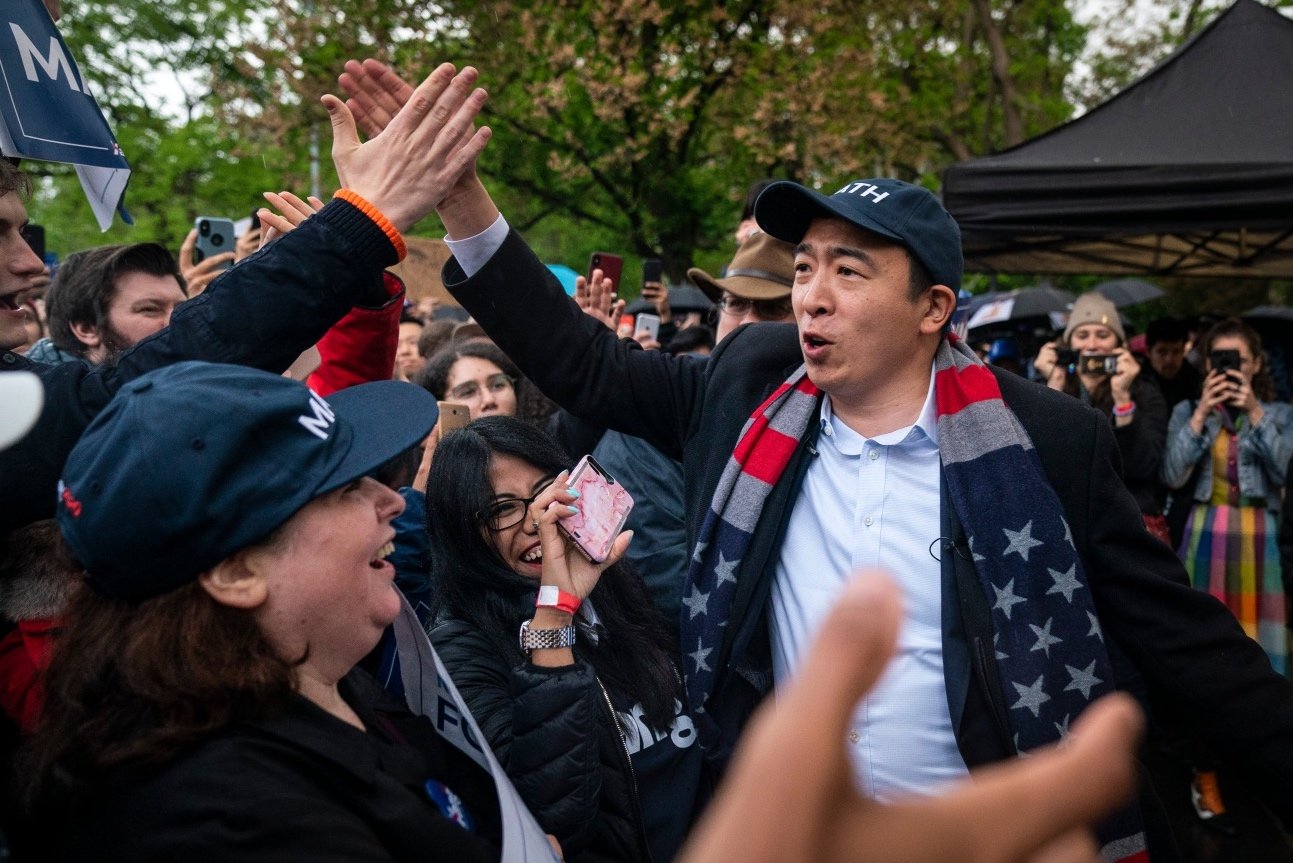
Our individual exhibits contribute to the sociology and discussions of Asian America by challenging these monolithic portrayals. Specifically, we utilize particular facets of the Asian American identity, such as gender and sexuality, to highlight the different struggles that Asian Americans have faced in the past and present. For example, Martin’s exhibit focuses largely on the social exclusion that queer Asian American actors have faced, and Kristine's exhibit provides an overview of the struggles and accomplishments of important Asian American women. Jack's exhibit focuses on political representation and how Andrew Yang's identity as a relatively young Asian American man affected his campaign. Sunny's exhibit focuses on the representation of Asian American actors and potential implications for Asian American masculinity.
Our exhibits are similar as they all connect to gender and representation in some capacity. For example, Jack’s exhibit relates to Sunny’s in that gender is a central part of Andrew Yang’s identity and candidacy. Martin’s project similarly relates to Sunny’s project in that it focuses on representation in Hollywood but focuses more on the rejection of queer Asian American actors face as a reflection of broader Asian American society. Finally, Kristine’s project brings attention to the exclusion of Asian American women and highlights their stories. Her exhibit is vital in completing the picture of Asian America, as the other exhibits largely center around Asian American men.
Methods of Data Collection
Regarding data point collection, members largely used Google to make the initial search for data that could be considered acceptable. After the initial search, members narrowed their data points based on the quality of the information provided as well as the credibility of the article. While the vast majority of data points for our team members are news articles, some data points collected were individualized according to the particular topic. One example is Martin’s dataset which includes video interviews about Hollywood representation.
Glossary
-
"the critical insight that race, class, gender, sexuality, ethnicity, nation, ability, and age operate not as unitary, mutually exclusive entities, but as reciprocally constructing phenomena that in turn shape complex social inequalities"
All identities are intersectional in some way. When the concept of the 'all-American' is invoked, however, most Americans do not think of an Asian American. In this sense, the intersection of race and nationality has implications for representation and power for Asian Americans. This exhibit explores the intersectionality of Asian Americans by further analyzing different facets of the Asian American identity.
1. Collins, Patricia Hill. 2015. “Intersectionality's Definitional Dilemmas.” Annual Review of Sociology 41(1): Pp. 2
-
numerical representation: "a social group’s presence or absence on-screen or behind-the-scenes, usually referring to the proportion of a particular occupation that the group occupies"
quality of representation: "the kinds of roles that groups occupy on-screen and behind-the-scenes. In front of the camera, actors favor multi-dimensional, multi-faceted roles over stereotypical, one-dimensional parts. Behind-the-camera directors and producers prefer to work in a range of genres rather than be [typecast], or relegated to niches"
centrality of representation: "assesses how central groups are to an industry’s core institutions"
We offer a three-pronged approach to defining representation given the complexity of issues that we tackle in our exhibits. While our definition of representation most strongly relates to the acting industry — given that two of our exhibits are related to Asian Americans in Hollywood — representation is still a relevant concept for each of our individual exhibits.
2. Erigha, Maryann. 2015. “Race, Gender, Hollywood: Representation in Cultural Production and Digital Media's Potential for Change.” Sociology Compass 9(1): Pp.79-80.
-
"a product of material conditions but is also a sometimes habituated, sometimes reflexive practice in which people engage in relation with each other"
For example, one's gender can be seen a product of who they interact with and what hobbies and activities they partake in. An example of gender as a practice is when someone is described as 'masculine' or 'feminine'.
Gender is an important term to understand for the sociology of Asian America as traditional concepts of gender have not always served Asian Americans well. For example, our exhibits highlight the normative standards of masculinity that Asian American men are held to and how the accomplishments of Asian American women lack visibility.
3. Holmes, Mary. 2011. Pp. 181 in What is gender?: Sociological approaches. Los Angeles, CA: SAGE.
-
the construction of fluid and dynamic "sexual identities, desires, and categories" that is "intertwined with, even sometimes constitutive of, power relations" related to race, class, and gender
Sexuality is an important concept for further understanding the sociology of Asian America because of the additional difficulties that LGBTQ+ identifying Asian Americans face in their daily lives. Martin's exhibit specifically highlights the experience of queer Asian Americans in Hollywood.
4. Gamson, Joshua and Dawne Moon. 2004. “The Sociology of Sexualities: Queer and Beyond.” Annual Review of Sociology 30(1): Pp. 49
Site Design
This site map was conceptualized as a tree that ‘branched’ vertically downwards into individual elements that hyperlink to our individual exhibits. Exhibits with closer connections would be placed closer together on the same ‘branch’. We chose this site map as our main idea for ease of readability and to emphasize the theme of branching identity.
Unfortunately, the block-style formatting of this website prevents us from achieving our full vision. Furthermore, it was not our intention to suggest linearity in examining the Asian American identity.
Like a Bonsai Tree
Using the bonsai tree as an analogy, the Asian American identity is molded to fit a certain shape that is considered pleasing. However, like the bonsai tree, our individual experiences have branches from the core identity of “Asian American” and are more complex than what an initial appearance may suggest. The bonsai analogy is merely an iteration of intersectionality rather than a brand new concept.


Gender - Indignant Women
Representation - The Bamboo Looking Glass: The New York Times’ Coverage of Andrew Yang

Sexuality - The Queer Identity: Representation of the Queer Asian Male Population

Representation - State of Asian Masculinity
Photo Credits
Angerer, Drew. 2019. Andrew Yang Wearing MATH Hat with Crowd. Retrieved 2021 (https://www.motherjones.com/politics/2019/11/andrew-yang/).
Campanario, G., 2021. Collage of historical Asian Actors. Retrieved December 16, 2021 [image].
Person. 2020. “Chien-Shiung Wu: 100 Women of the Year.” Time. Retrieved December 16, 2021 (https://time.com/5793522/chien-shiung-wu-100-women-of-the-year/).
Ziff, Brian. n.d. “Playboy X Bretman Rock Digital Cover.” Playboy x Bretman Rock. Retrieved (https://www.playboy.com/custom/bretman-rock-exclusive-playboy-digital-cover).